
Understanding Liquid and Air Cooling: Which Fits Your Facility?
As technologies such as AI and cloud computing evolve at a rapid pace, traditional cooling solutions often struggle to maintain the necessary temperatures for high-density server racks. According to Data Center Trends 2025 by Vertiv, rack densities are projected to rise to between 500 and 1000kW in AI-driven facilities. Such growth demands more sophisticated cooling systems to prevent overheating and costly unplanned shutdowns.
How Do Liquid and Air Cooling Systems Work?
Effective data center cooling is crucial for operational stability. Equipment generates heat that needs to be efficiently dissipated to avoid system failures. Air cooling uses air as a means to capture and move heat away from vital IT components, making it suitable for less dense environments. Precision systems are tailored to provide rack, row, and room level cooling solutions, like the Liebert PDX Compact DX Cooling System or the Liebert® CW Chilled Water-cooling System.
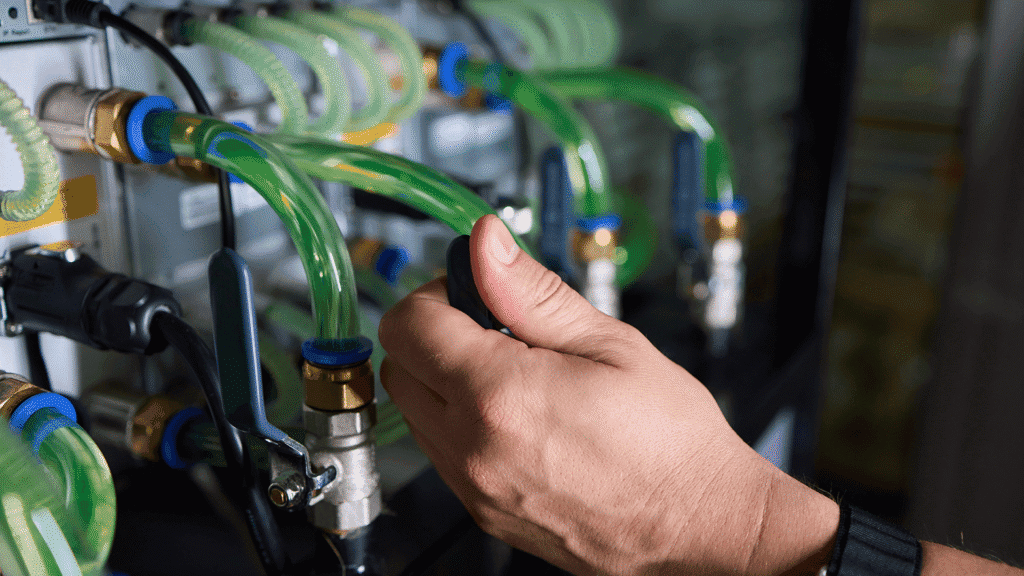
Liquid cooling, in contrast, employs water or specialized nonconductive liquids that flow through or near the equipment, absorbing and lowering the heat before recirculating. This system is more capable of handling higher densities compared to air-based solutions. Liquid cooling can be implemented in several forms:
- Direct-to-chip cooling: Delivers coolant directly to server chips, exemplified by the Vertiv™ CoolChip CDU.
- Rear door heat exchangers: Mounted on the back of server racks to dissipate expelled heat, like the Liebert® DCD Water-Cooled Passive Rack Door.
- Immersion cooling: Encloses the server in a nonconductive liquid to absorb generated heat.
These methods surpass air cooling in efficiency for high-density environments.
Determining the Right Cooling System for Your Center
When choosing a cooling strategy for your data center, consider your rack density. Air cooling is typically adequate for low-density racks, which use less than 20kW and thus generate less heat. An air room cooling system, such as the Liebert DS Direct Expansion Cooling System, could effectively replace hot air with cooler air.
For racks with densities exceeding 20kW, particularly those over 30kW, liquid cooling becomes essential. The increased power consumption generates more heat than air-based systems can efficiently manage, making liquid cooling a necessity. A hybrid approach, combining both air and liquid cooling, often offers an optimal solution for heat removal.
Many data centers are now adopting hybrid cooling methods to adapt to the demands of AI and high-density computing while keeping costs manageable. Products designed for this dual-purpose, like the Vertiv™ CoolChip CDU, ensure efficient temperature management with less energy consumption.
Explore Solutions to Maintain Your Facility’s Optimal Conditions
Crafting the ideal environment for your equipment extends beyond just temperature and rack density considerations. A well-organized, up-to-date setup is crucial for seamless operations. Stay informed about the latest in cooling infrastructure and technological advancements by subscribing to our newsletter.
To learn more about how liquid cooling can transform your facility’s efficiency, contact Innovative Technology Solutions at 913.492.0770. Our team is ready to help design a cooling strategy tailored to your specific needs.
Frequently Asked Questions
1. What is the main advantage of liquid cooling over air cooling?
Liquid cooling is better suited for high-density environments because it can dissipate more heat than air, making it ideal for modern data centers.
2. Can liquid cooling be used alone in data centers?
While possible, liquid cooling is often combined with air cooling in a hybrid model to maximize efficiency and temperature regulation.
3. Is liquid cooling more energy-efficient?
Yes, by using less energy-intensive methods like pumps instead of compressors, liquid cooling can significantly reduce power usage.
4. When should a data center consider switching to liquid cooling?
If rack densities exceed 20kW, particularly around 30kW or more, liquid cooling should be considered to efficiently manage heat.
5. How can I determine the best cooling method for my facility?
Contact our experts at 913.492.0770 for a tailored assessment of your data center’s cooling needs.